War of 1812 · Williamsville, New York

Cantonment
Williams Ville

A Forgotten Encampment & Burial Ground

A chapter of the War of 1812 that has been entirely forgotten — an encampment built in haste, argued over in court, and then swallowed by time. For two centuries, the exact footprint of that encampment has been lost. But the most intriguing part of this story is not the huts. It is what may have been left behind.

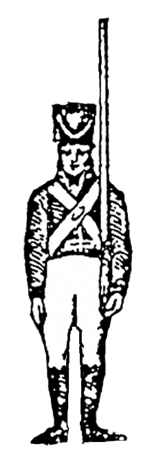
War of 1812 Soldier

The Encampment

Cantonment Williams Ville — the main body of troops stationed on the north side of Main Street, with long rows of log barracks stretching from the spring almost to Ellicott Creek.

The Dispute

Jonas Williams returned from Albany to find his finest trees gone and an army cantonment built on his land. He sued officers for thousands of dollars — one of the most remarkable civil disputes of the war.

The Burial Ground

A place mentioned only in passing, never mapped, never marked. As the trail of evidence unfolded, it pointed not just to where the cantonment was — but to something far more solemn.

A Cantonment
Nearly Erased

Most people in Western New York know about the Williamsville War of 1812 Barracks and Hospital. But few, if any, know of the main Cantonment named Cantonment Williams Ville. That story has lived only in fragments scattered through vague references in history books.

Imagine the winter of 1812. Riflemen ordered to build huts on land that was not theirs. Jonas Williams returned from Albany to find his finest trees gone and an Army Cantonment built upon his land — he was furious, but powerless. He sued officers for thousands of dollars.

And in the middle of this turmoil, a cantonment of log huts rose along the creek, and remained there for the entirety of the war, then vanished as quickly as it appeared.

For two centuries, the exact footprint of that encampment has been lost. But as I followed the trail through the Hopkins papers, the Coles and Schuyler letters, and the shifting land ownership, a pattern began to emerge — one that pointed not just to where the cantonment was, but to something far more solemn: a burial ground.

"A burial ground. A place mentioned only in passing, never mapped, never marked, and never connected to the Rifle Cantonment… until now."

— J. A. Buscaglia
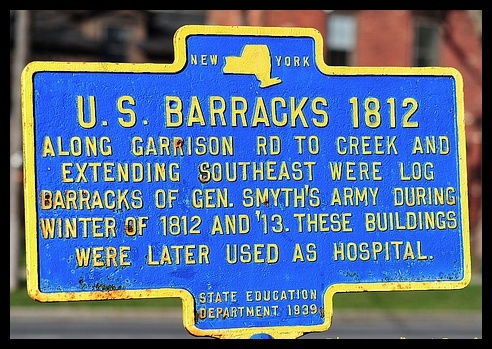
Williamsville Historical Marker Historical marker at Main and Evans, Williamsville

The Documentary
Evidence

Six primary sources — manuscripts, letters, and deeds — that together reconstruct the location, extent, and contested history of Cantonment Williams Ville.

Hopkins Manuscript
Source 01
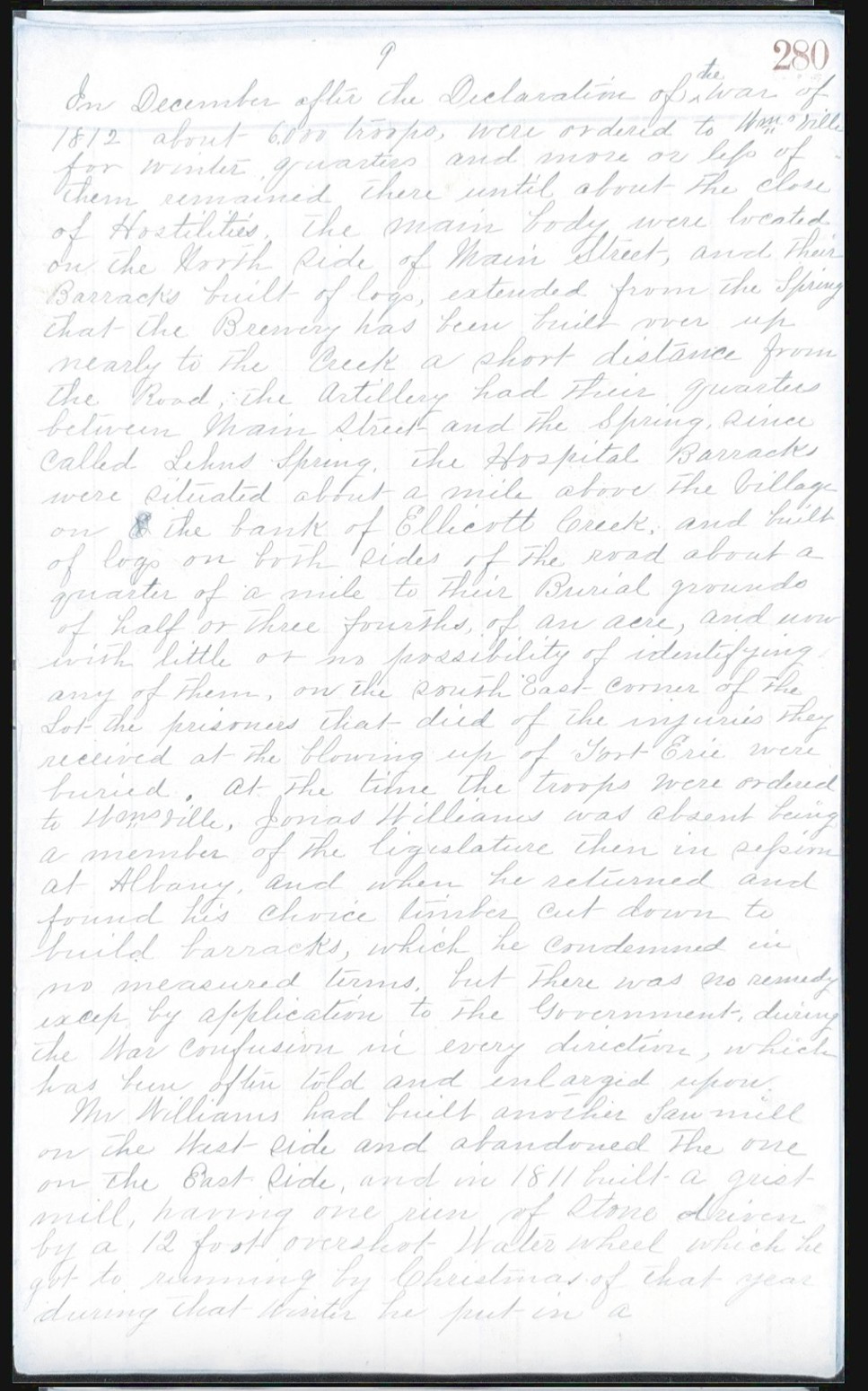
The Timothy A. Hopkins Manuscript
Buffalo History Museum

One of the most important early sources for understanding the scale of the Williamsville encampment. Hopkins recalls that shortly after the declaration of war, about six thousand troops were ordered to Williamsville for winter quarters, and many remained until the end of hostilities.

He describes the main body of soldiers stationed on the north side of Main Street, with long rows of log barracks stretching from the spring — later the site of the brewery — almost to the creek.

Hopkins also recounts how Jonas Williams was away in Albany serving in the state legislature, and upon return found much of his best timber had been cut down to build the barracks.

Coles Letter
Source 02
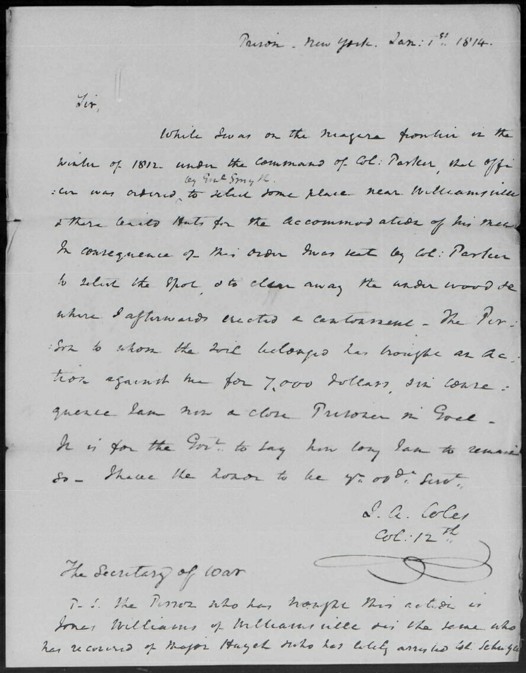
Col. Coles Letter to the Secretary of War
January 1, 1814

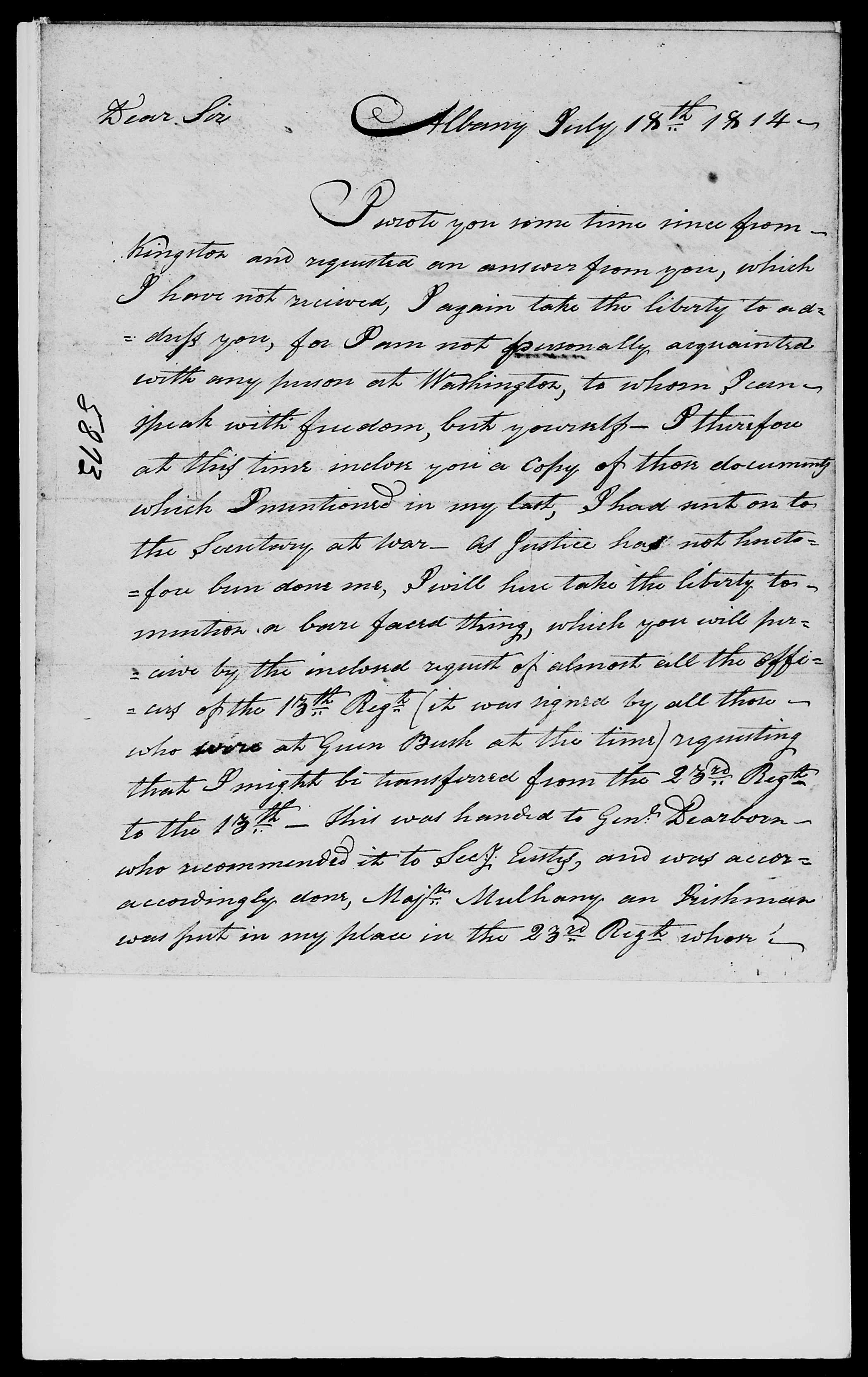
Colonel I. A. Coles explains that during the winter of 1812, he was ordered by General Smyth through Colonel Parker to select a site near Williamsville and clear it for cantonment. He describes choosing the spot, cutting the undergrowth, and erecting the huts that housed the troops.

Jonas Williams filed a lawsuit against him for seven thousand dollars — a staggering sum at the time. Coles writes that because of this suit, he is being held as a "close prisoner," waiting for the government to decide his fate.

This letter is extraordinary because it confirms not only the location of the cantonment but also the intensity of the dispute — giving us a firsthand glimpse into the friction between military necessity and private property.

Schuyler Letter
Source 03
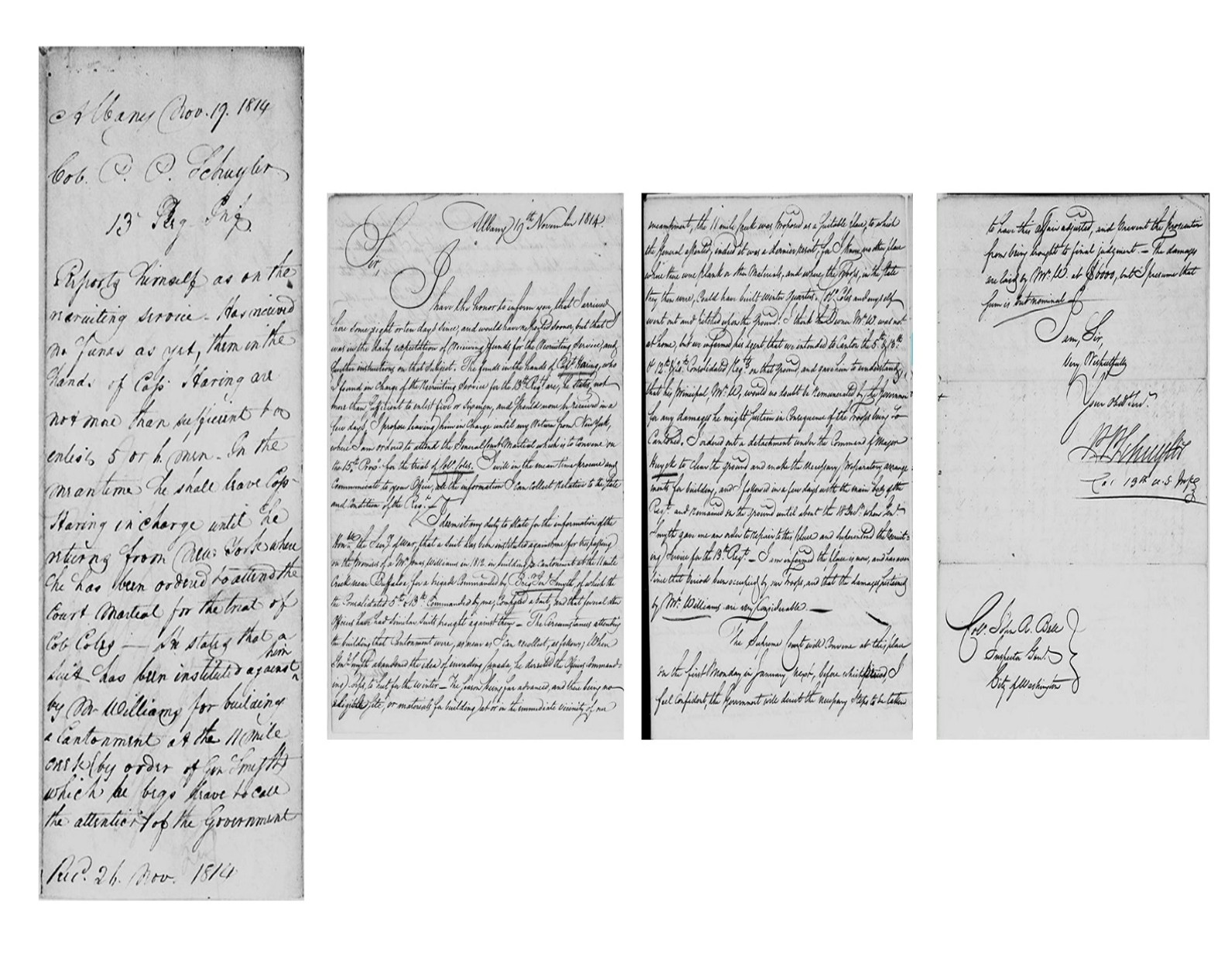
Col. Schuyler Letter to Secretary of War
November 19, 1814

Colonel P. P. Schuyler confirms beyond any doubt that Jonas Williams sued the U.S. Army for trespassing, and that the military cantonment was built on his land. Schuyler recounts how, after General Smyth abandoned plans to invade Canada, the officers were ordered to "hut for the winter."

"With the season already far advanced and no suitable building materials near their existing encampment, the Eleven Mile Creek site became, as he put it, 'a last resort.'"

By 1814, the cantonment had been occupied continuously by U.S. troops, and damages to Williams' property were described as "very considerable" — with Williams' claim set at six thousand dollars.

Williams Deed
Source 04
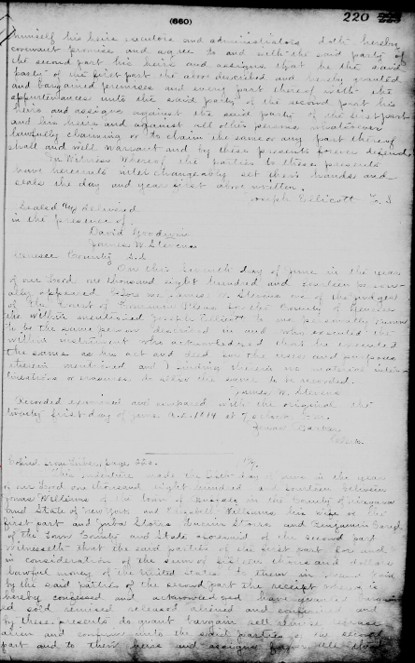
Williams to Storrs, Lucius Storrs & Caryl Deed
June 5, 1814 — Liber 1, Page 220

While all of these lawsuits were unfolding, Jonas Williams received an offer from Juba Storrs & Company to purchase two parcels of his land — including the northern parcel that once contained the Infantry Cantonment — for fifteen thousand dollars.

Williams added a critical clause: he was "saving and reserving any right of action" against anyone in the United States Army for anything they had already done on the property. Even as he sold the land, he kept the right to pursue damages.

This single line in the deed confirms that the military's use of his land was significant enough that he wanted those claims preserved, even as he walked away from the property itself.

Sheldon Letter
Source 05
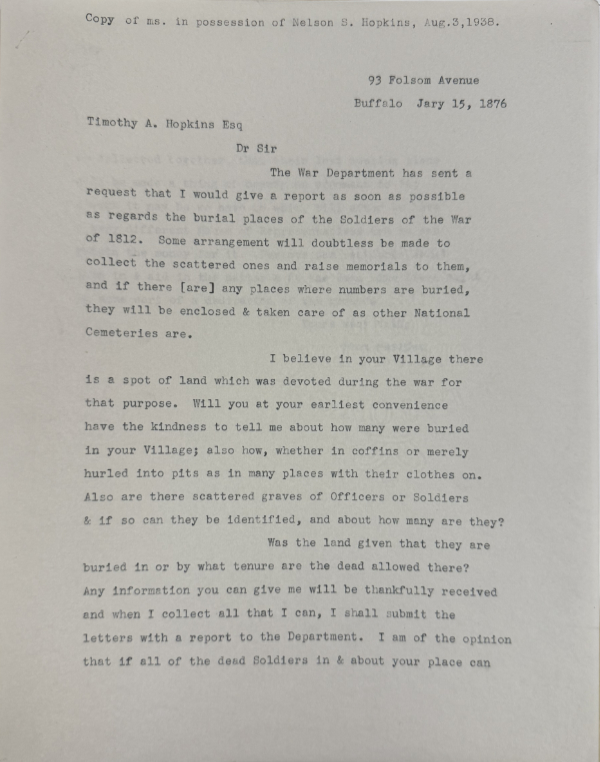
Alex Sheldon Letter to T. A. Hopkins
January 15, 1876 — Buffalo History Museum

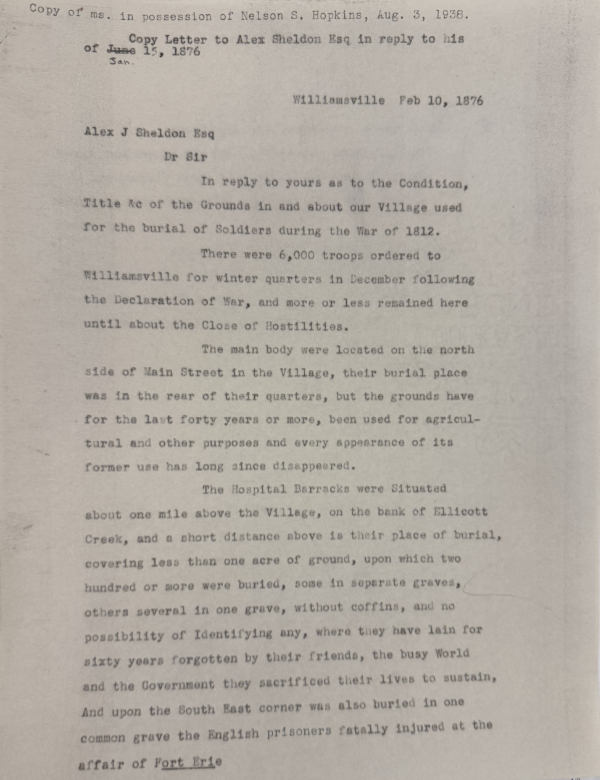
By 1876, the War of 1812 was fading from living memory, and the War Department began gathering information about where American soldiers had been buried. Alex Sheldon, librarian of the Grosvenor Library, wrote to T. A. Hopkins seeking details about the Williamsville burial ground.

Sheldon asks: How many soldiers were buried in the village? Were they buried in coffins or placed in mass graves? What was the legal status of the burial ground?

This letter is significant because it shows that, decades later, federal officials still recognized Williamsville as a place where War of 1812 soldiers had been buried, and turned to the Hopkins family for firsthand knowledge.

Hopkins Reply
Source 06
T. A. Hopkins Reply to Alex Sheldon
February 10, 1876 — Buffalo History Museum

Hopkins' reply is one of the most important pieces of evidence for what happened within the village during the War of 1812. He reiterates that six thousand troops were ordered to Williamsville, and that the main body was stationed on the north side of Main Street.

"Their burial place was in the rear of their quarters" — a single extraordinary line that identifies the location of a second War of 1812 burial ground within the village, one that had vanished from the landscape but not from the written record.

Hopkins adds that the land had been farmed for more than forty years, and that all visible traces of the burial site had long since disappeared.

Mapping the
Cantonment Site

A series of land ownership and village maps trace the transformation of the cantonment site from military encampment to modern neighborhood.

1812
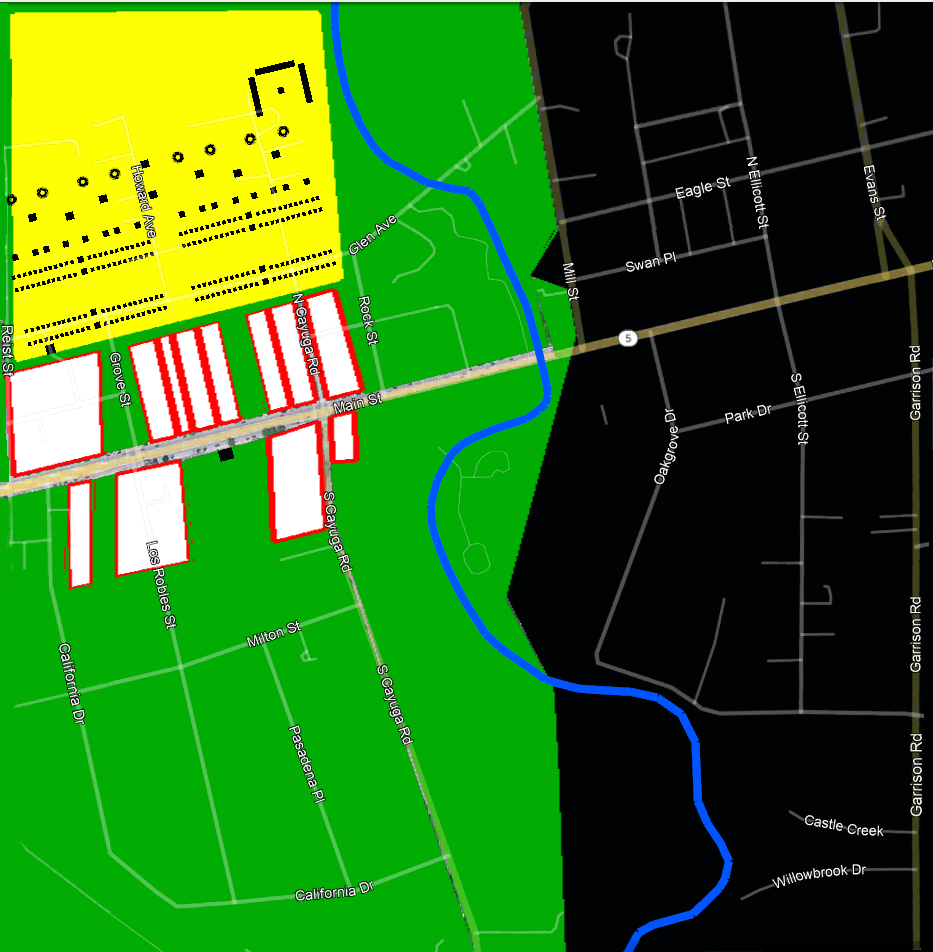
Lot 1 Land Ownership — Year of 1812

Before the war, Jonas Williams had already begun selling off portions of his land. He sold roughly 135 acres east of Ellicott Creek to Isaac Bowman, and conveyed nine village lots west of the creek along Main Street. The yellow area marks the Rifle Cantonment location. Black: Bowman land. Green: Williams land.

1812 land ownership map
1814
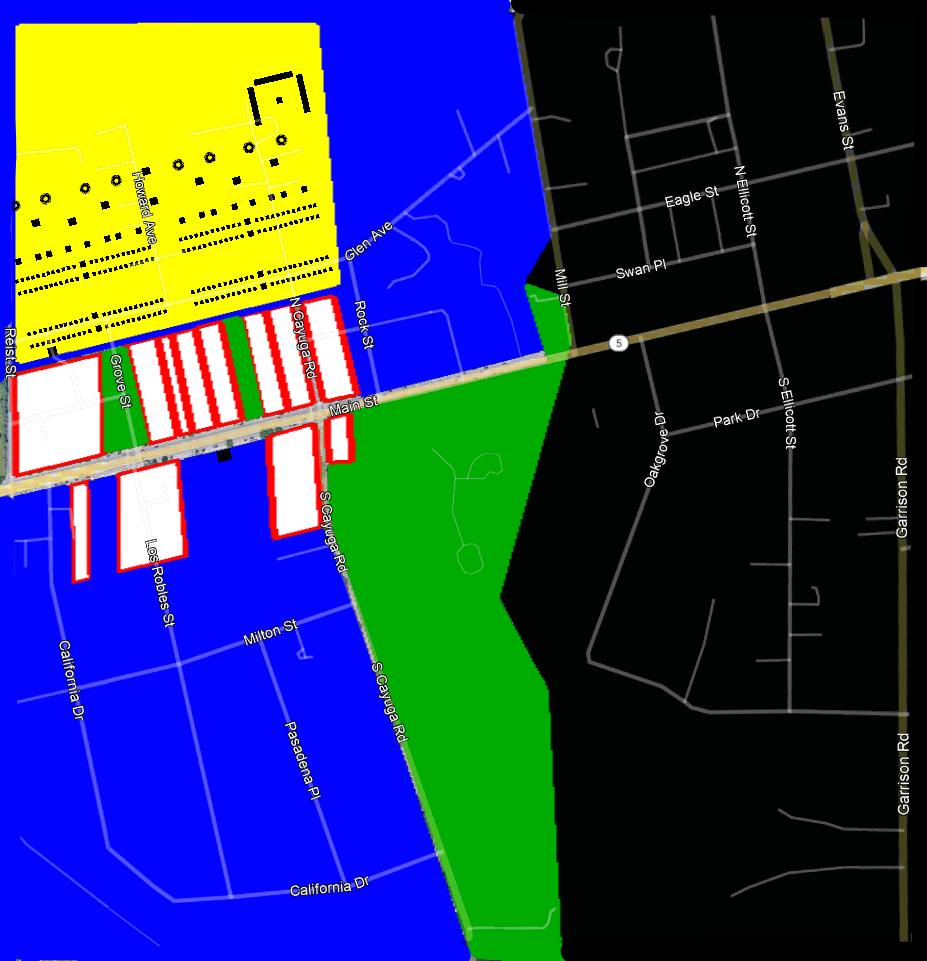
Lot 1 Land Ownership — Year of 1814

In 1814, Jonas Williams sold a large portion — including the northern parcel containing the Infantry Cantonment — to Juba Storrs & Company. The deed included a clause retaining Williams' right to sue for damages. Blue: Juba Storrs land. Yellow: Cantonment area.

1814 land ownership map
1854
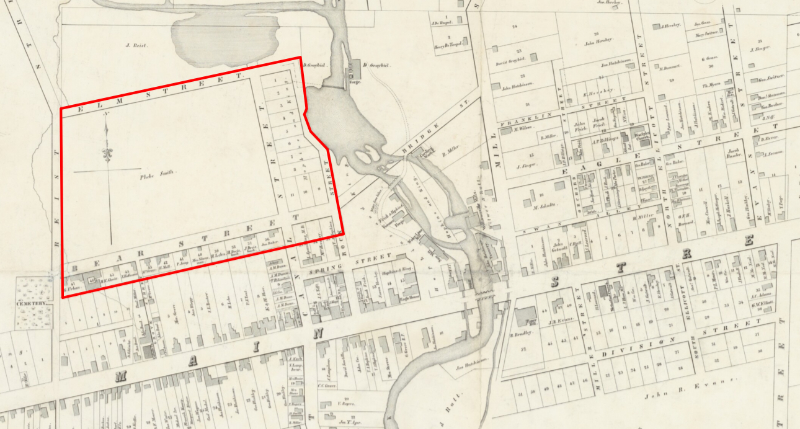
Village Map of Williamsville

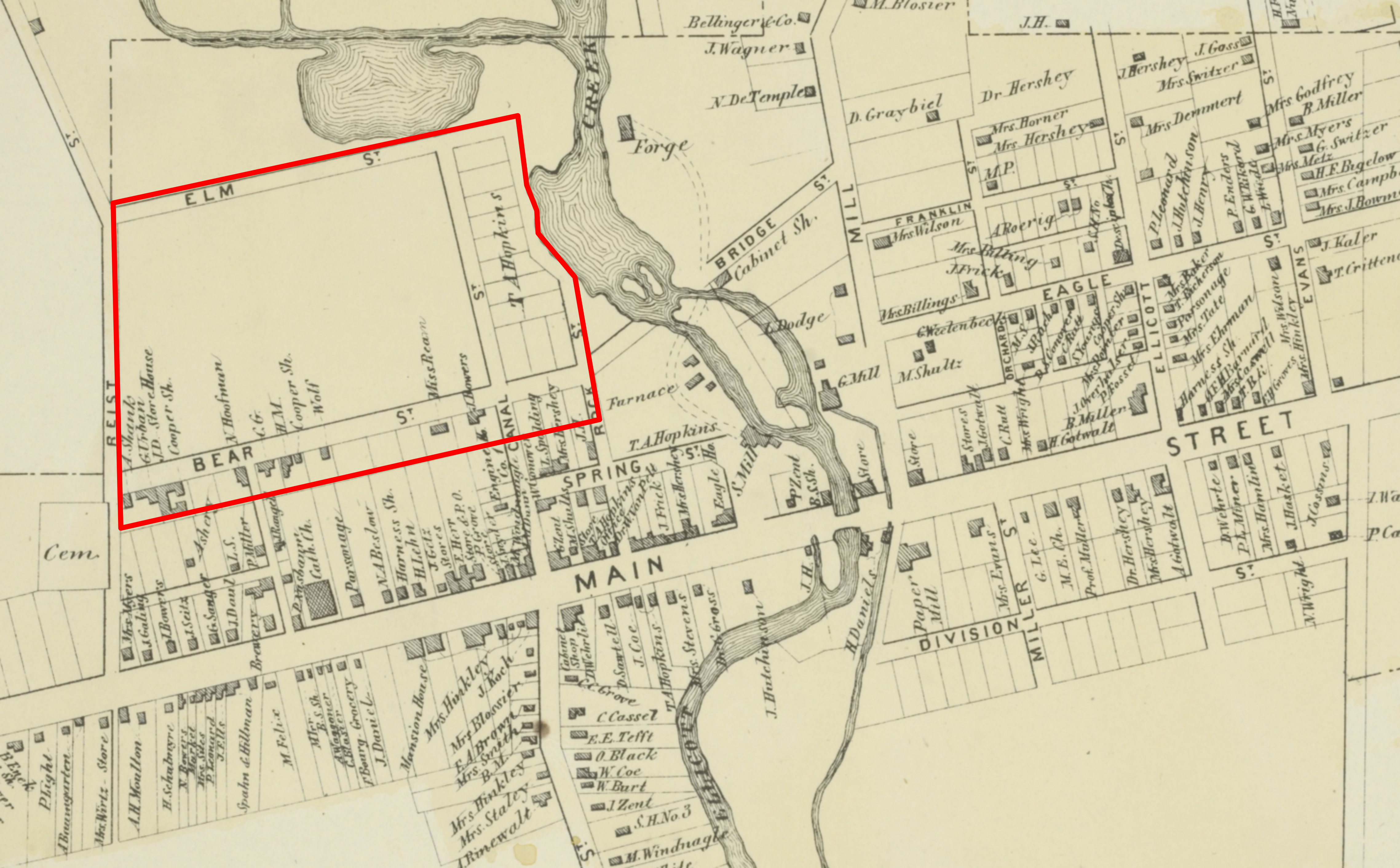
One of the earliest visual records of the community. The red outline marks the area believed to be the Infantry Cantonment — notably open and undeveloped. These parcels were held by Phebe Smith and Timothy Hopkins, whose family maintained deep ties to the site's military history.

1854 village map
1866
Village Map of Williamsville

The 1866 map shows no owner listed for the cantonment area except T. A. Hopkins. The land remains entirely vacant — more than fifty years after the encampment, the ground is still undeveloped and largely unchanged.

1866 village map
1880
Village Map of Williamsville

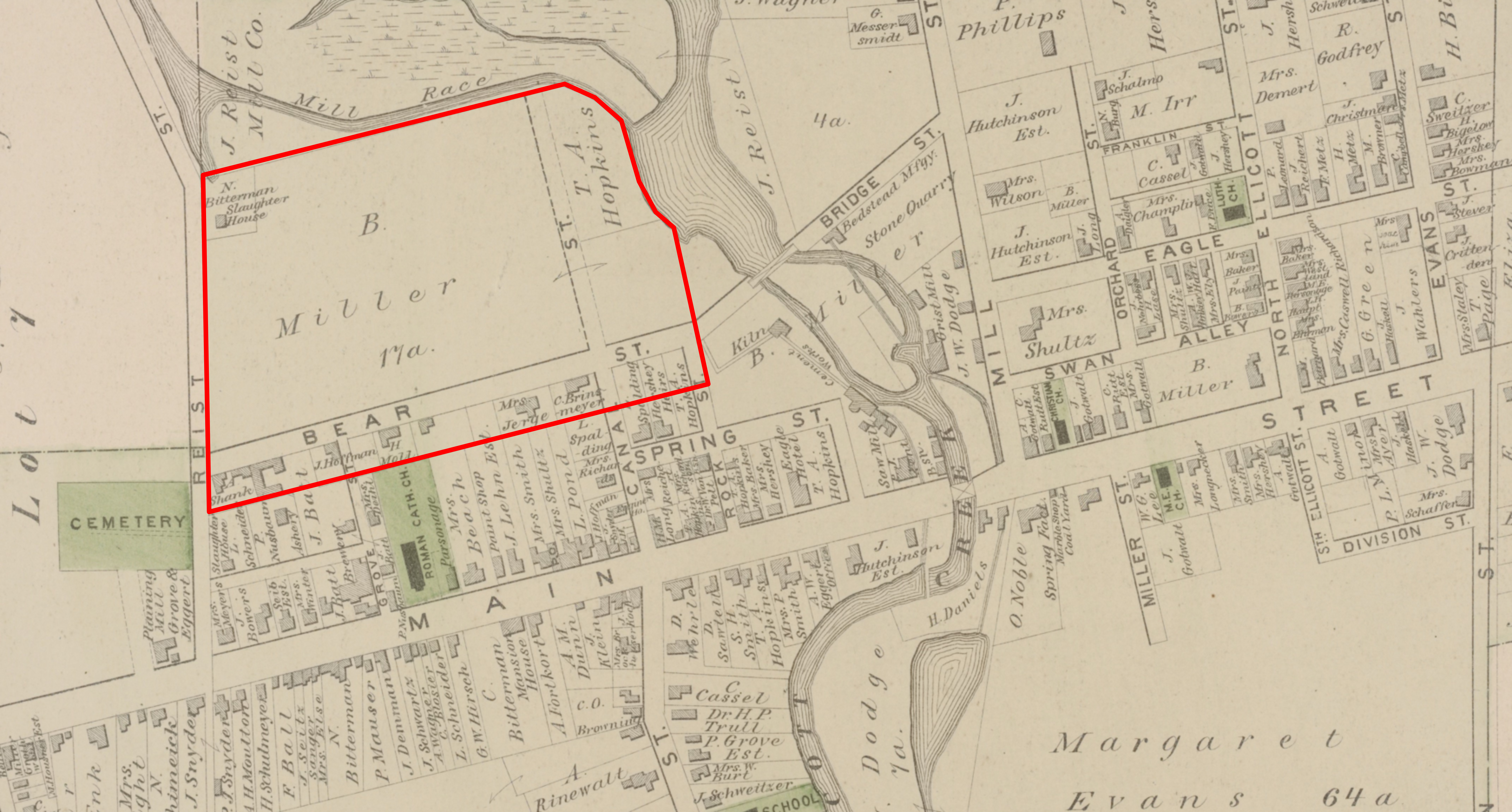
The property is now owned by B. Miller and T. A. Hopkins, but remains almost entirely vacant. The only development is the N. Bitterman Slaughterhouse in the northwest corner — a reminder of how slowly this part of the village filled in.

1880 village map
1909
Village Map of Williamsville

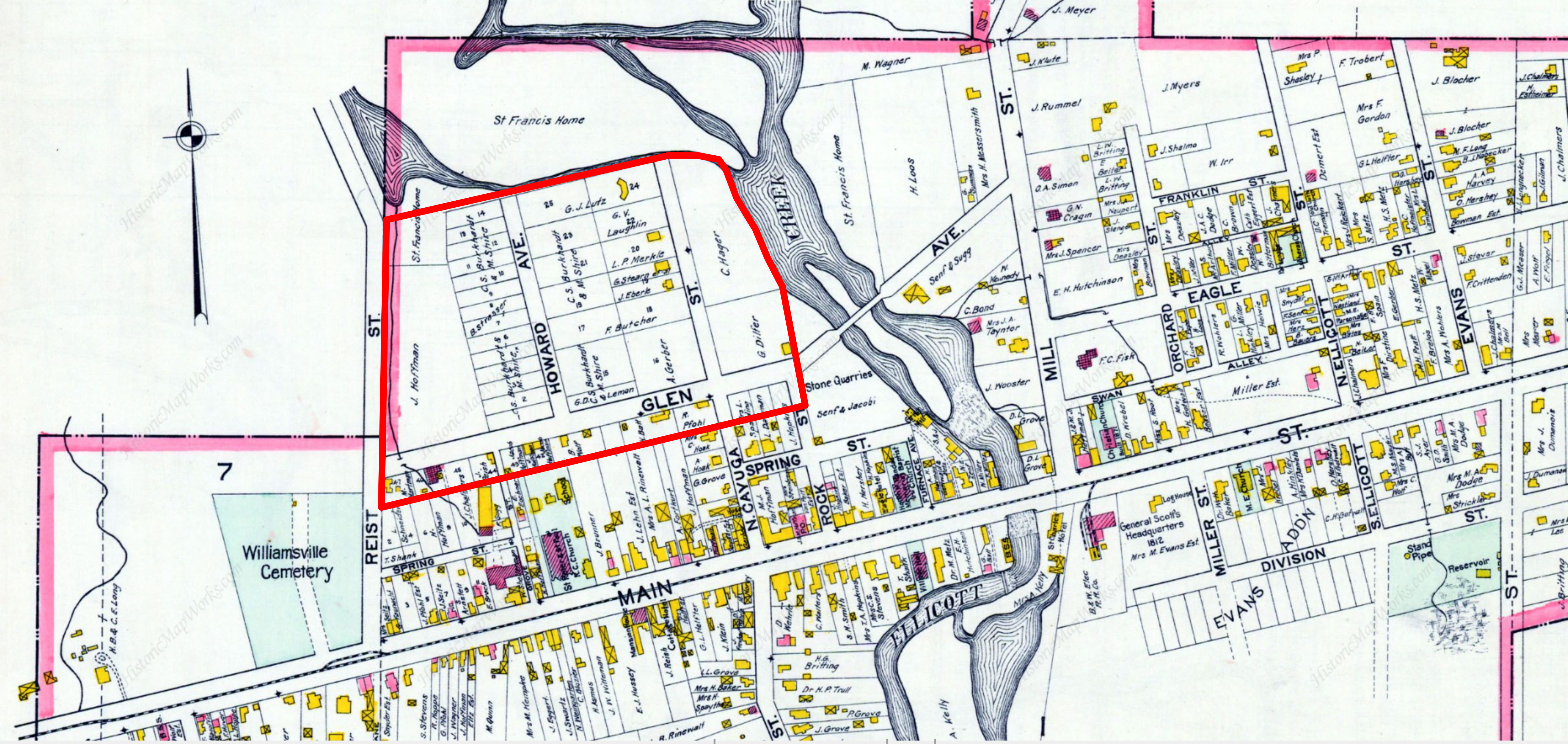
By 1909, the cantonment site is fully divided into residential lots with five houses built — the first significant wave of development. This map captures the moment the former cantonment area transitions from open ground into a true neighborhood.

1909 village map
1927
Aerial Photograph — Cantonment Area

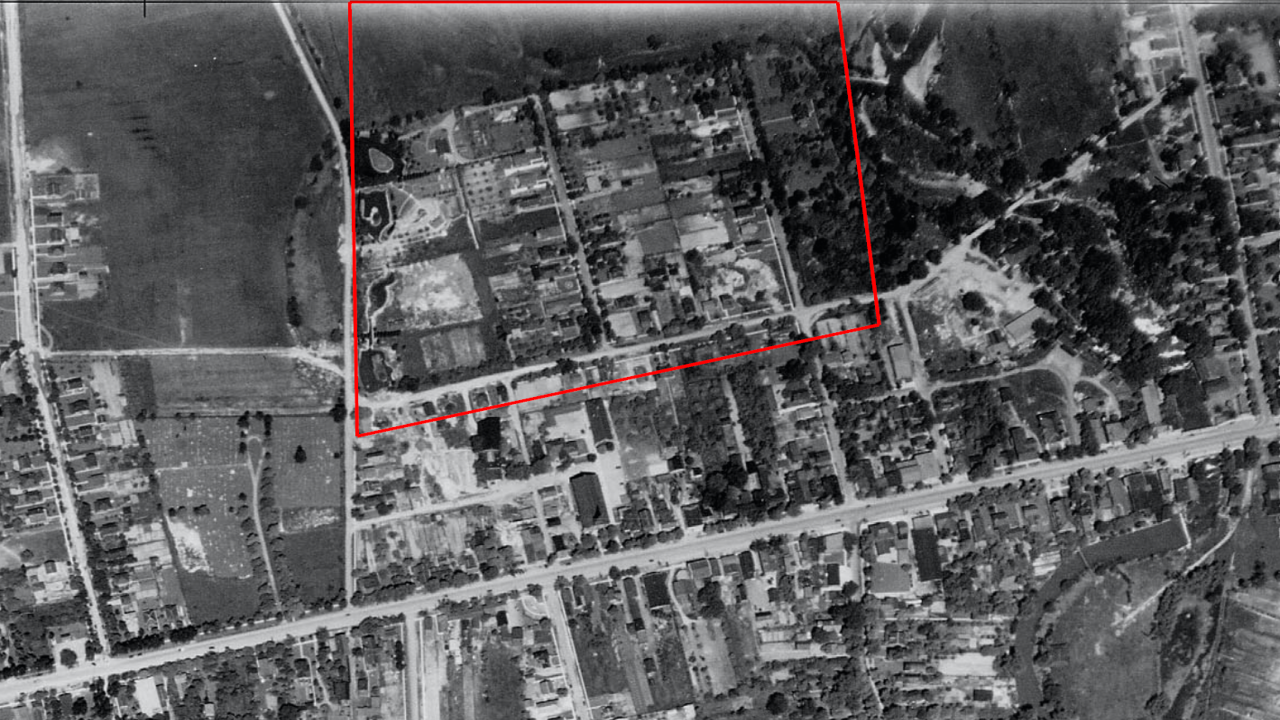
The 1927 aerial shows how dramatically the old Rifle Cantonment area has changed. Streets are laid out, houses built — the last traces of the military grounds have disappeared into the growing community. The end of one chapter, the beginning of another.

1927 aerial photo

Cantonment Layout &
Hut Construction

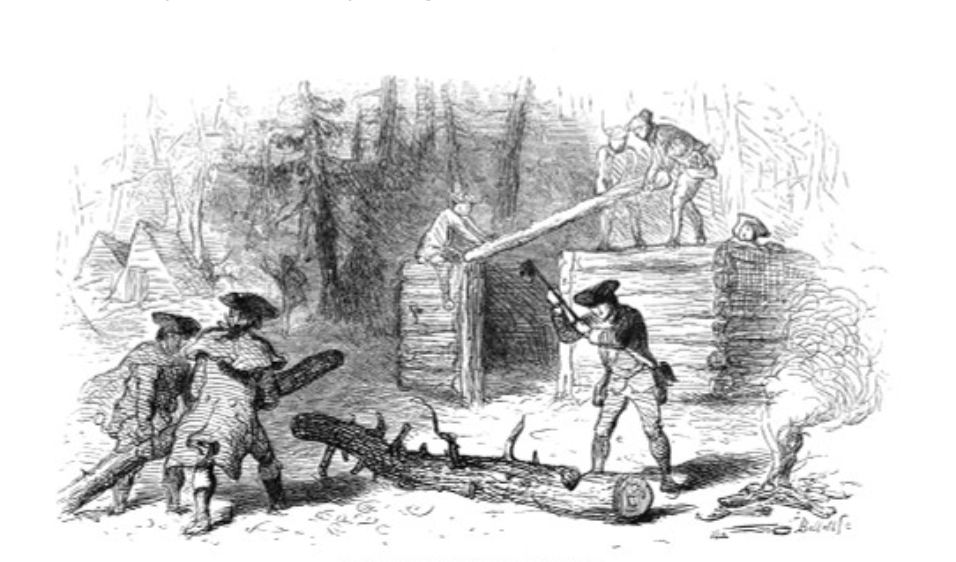
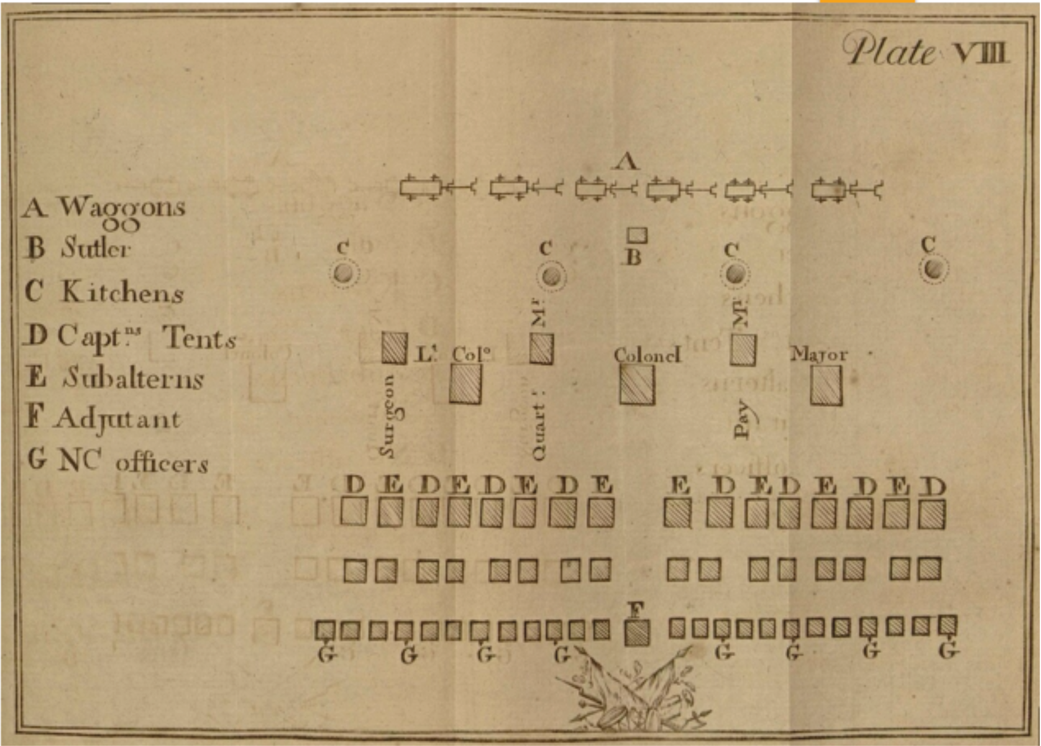
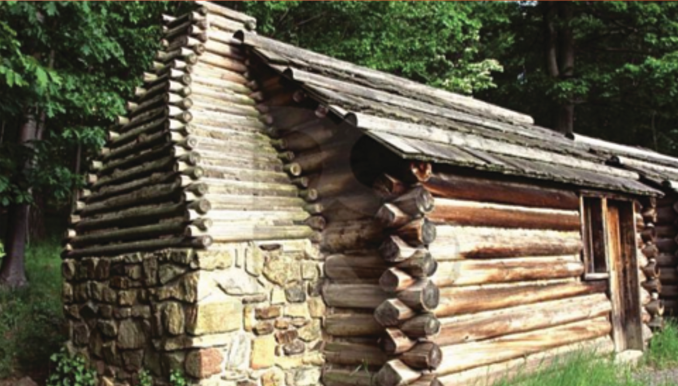
The Williams Ville Cantonment would have been laid out similarly to General von Steuben's camp design — soldiers living in simple log huts arranged in long rows, built by the twelve men intended to occupy each one.

Hut construction diagram Von Steuben camp layout General Friedrich Wilhelm von Steuben, Regulations for the Order and Discipline of the Troops of the United States (1794), Plate 8 Valley Forge hut model

"The next thing is the erecting of the huts; they were generally about twelve by fifteen or sixteen feet square… the two end sticks which held those that served for plates were made to jut out about a foot from the sides and a straight pole made to rest on them, parallel to the plates… A chimney was then built at the centre of the backside, composed of stone as high as the eves and finished with sticks and clay, if clay was to be had, if not, with mud."

Joseph Plumb Martin — A Narrative of a Revolutionary Soldier

"I believe that the same kind of Soldier Huts were constructed in the War of 1812 as they were during the Revolutionary War at Valley Forge. I don't believe Hut Technology advanced much during that bit of time."

— J. A. Buscaglia

The Location &
Conclusions

Based on the convergence of historical sources, Buscaglia concludes that the area bounded by Reist Street on the west, North Cayuga Road to the east, Glen Ave on the south, and the Amherst State Park to the north is where the Rifle Cantonment and Arsenal was located.

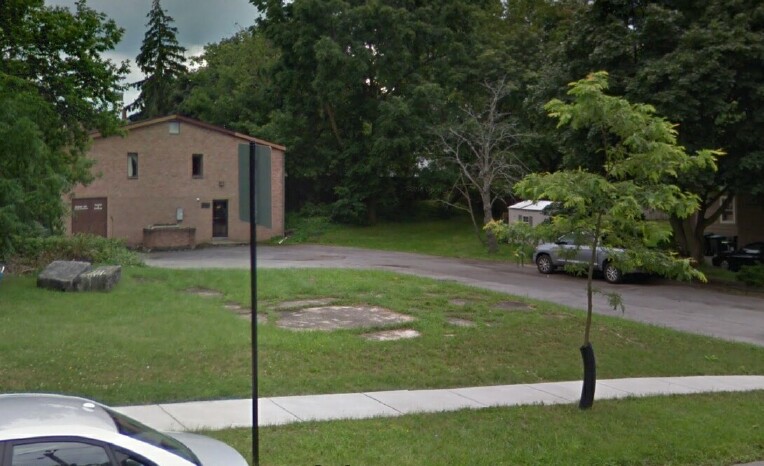
This area also contains a natural spring near the corner of West Spring Street and Grove Street — a water source essential for sustaining a cantonment of this size. Other 19th-century ruins in the same area are believed to be remnants of the cantonment.

Most compellingly, a hidden limestone chamber at the rear of 34 West Spring Street — bounded by 87 and 109 Glen Ave — is believed to be the hidden basement of the Arsenal where black powder was stored, consistent with similar War of 1812 arsenals in New York State.

"O'Bryan had seen the Devil when on post at the sally port leading to the graveyard."

— Major Mordecai Myers, Reminiscences 1780–1814 (Washington, 1900)

This remarkable passage places a sally port leading directly to a graveyard within the cantonment — further supporting the presence of a burial area in close proximity to the barracks. At the time, the only known graveyard in Williamsville was the Long family graveyard — now the Williamsville Cemetery — first used for burials in 1810.

Corroborating Sources

T. A. Hopkins Reminiscences — soldiers stationed on the north side of Main Street; log barracks from the spring almost to the creek
Coles & Schuyler Letters — cantonment constructed in Williamsville on land owned by Jonas Williams, with lawsuits to follow
Williams–Storrs Deed (1814) — clause reserving right of action against the U.S. Army confirms prior military use of the land
Hopkins 1876 Letter — "their burial place was in the rear of their quarters," identifying a second burial ground within the village
Major Mordecai Myers — sally port from the cantonment led directly to the graveyard
Historian Sue Miller Young — arsenal and barracks on the north side of Main Street, between SS Peter and Paul Church and Glen Falls
History of Buffalo & Niagara Falls (1896) — "a long row of barracks was built parallel with Main Street, and a little north of that thoroughfare"
Fresh-water spring — located at the corner of West Spring Street and Grove Street, essential for sustaining a large cantonment

Ruins & Present-Day
Site Imagery

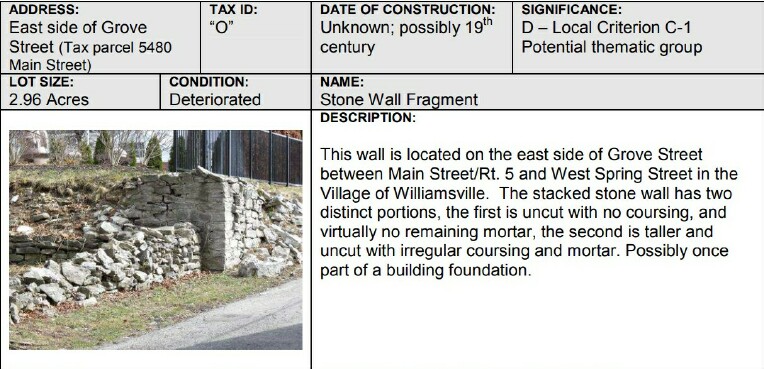
19th century ruins
19th Century Ruins

Other 19th-century ruins in the same area as the proposed cantonment location are believed to have been part of the military encampment.

87 Glen Ave hidden basement
The Hidden Arsenal Basement — 87 Glen Ave

Two large stone blocks on the left-hand side mark the location of the proposed hidden Arsenal basement entrance. Consistent with similar War of 1812 arsenals, such as the Onondaga Arsenal in Syracuse, the black powder would have been stored in this underground chamber.

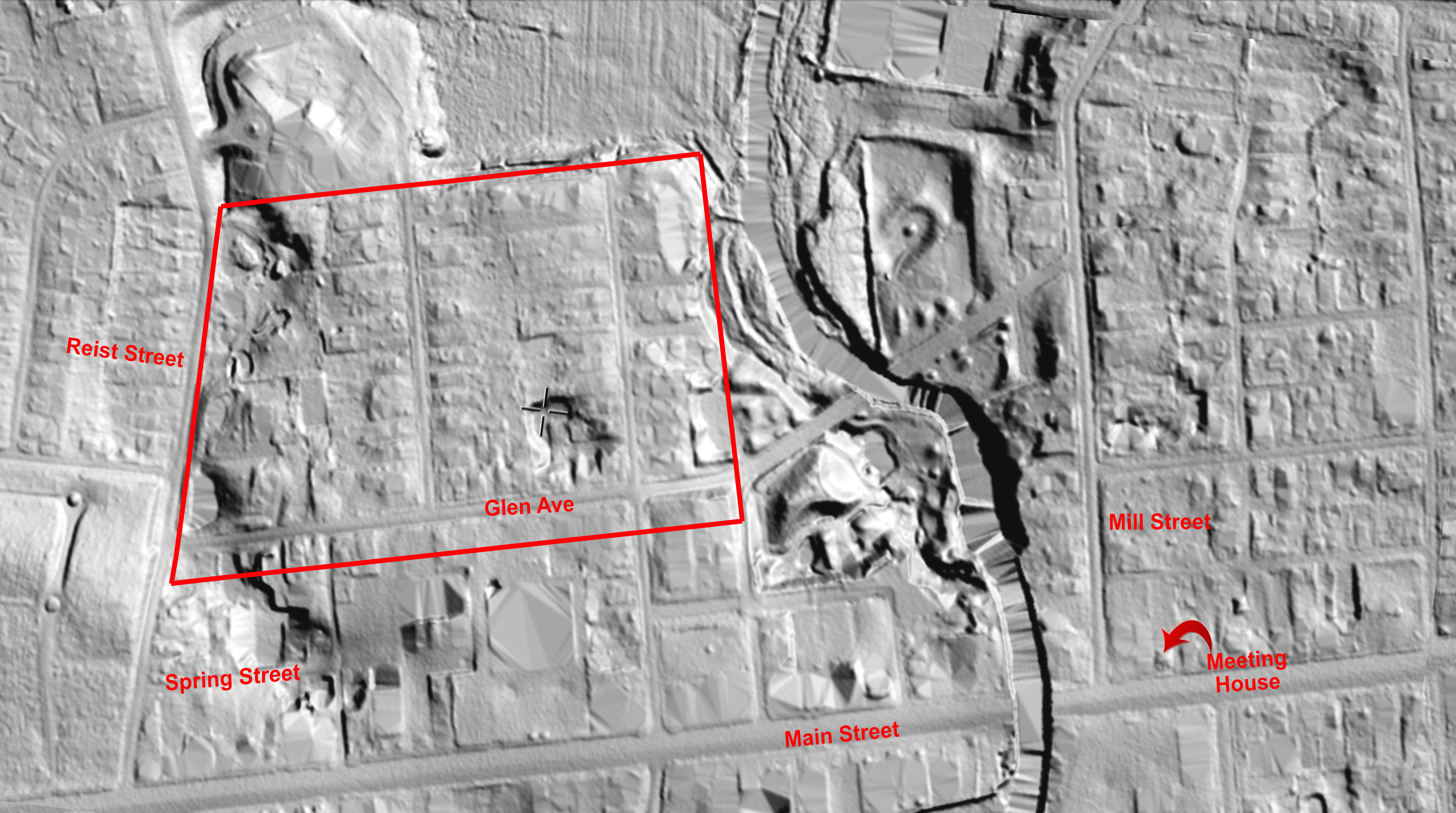
LiDAR imagery
LiDAR Imagery of the Cantonment Area

Even though the physical traces of the cantonment have disappeared, this modern topographic view helps imagine where the forgotten burial ground might still rest beneath the modern neighborhood.

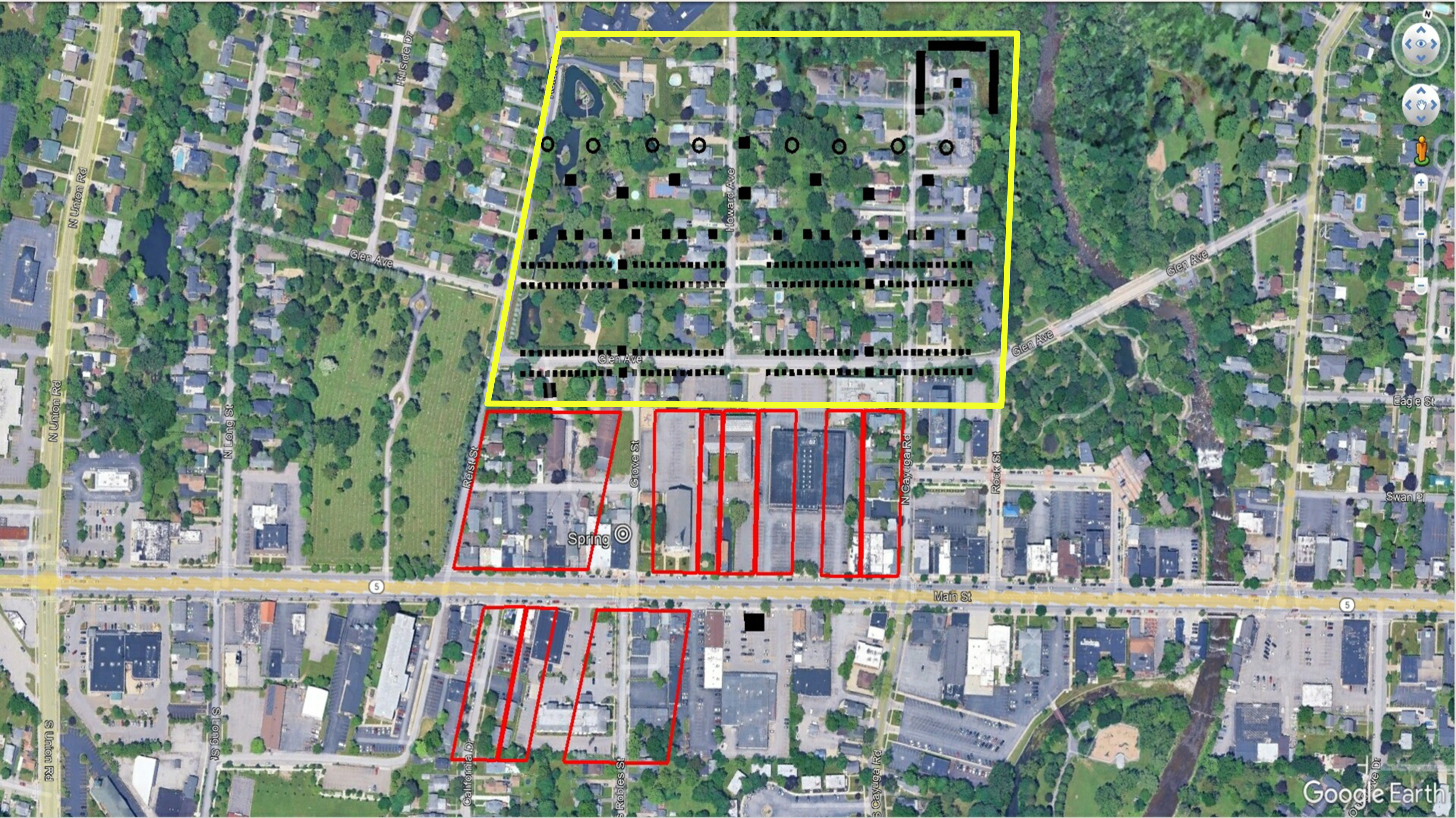
Present day satellite
Present-Day Satellite Overlay

Overlay marking where the Infantry Cantonment likely stood and the lots once sold by Jonas Williams — connecting early land use to today's residential and commercial development.

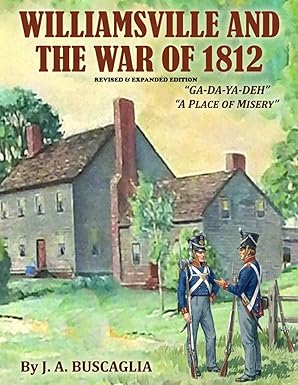
Williamsville and the War of 1812 book cover
Further Reading
Williamsville and the War of 1812

More on the War of 1812 Rifle & Artillery Cantonments at Williamsville, New York — including the full account of the Cantonment, the burial ground, and the soldiers who served there — is available in this book by J. A. Buscaglia.

View on Amazon →

Questions & Comments

Please direct all inquiries to J. A. Buscaglia

[email protected]